
Spotlight on the Eurasian lynx, the elusive lord of the forests
Larger than a cat, the lynx stands between 50 and 75 cm at the withers and can be over a metre long. Its grey-brown coat speckled with black, its long, powerful legs and its tufted ears make it easily recognisable… if you’re lucky enough to catch a glimpse of it.
Solitary and extremely elusive, it inhabits forests and mountainous areas. It is mainly active at night and can cover a vast hunting territory, spanning up to several hundred square kilometres.
It kills around sixty roe deer or chamois a year, which is still a very small number compared with other causes of mortality affecting these animals. Extremely patient, with keen hearing and a highly developed sense of smell, the lynx can wait several days along a prey’s usual route before pouncing.
A protected species in France, the lynx was reintroduced into the Swiss Alps, the Jura and the Vosges between the 1970s and 1990s. It plays a key role in regulating animal populations and helps maintain the balance of forest ecosystems.
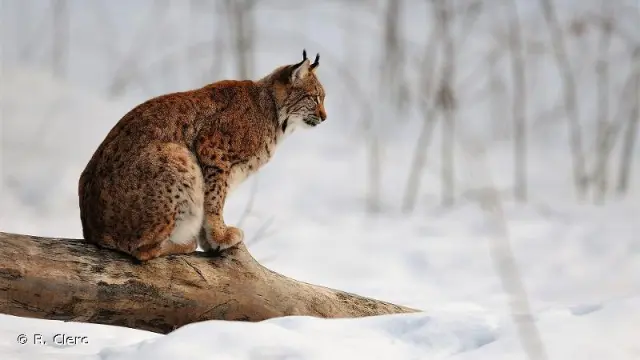
Lynx Boreal
Hide and seek
The presence of a lynx can be detected by the clues it leaves behind: hairs left on the wood when it rubs against it, claw marks on tree trunks, and above all its droppings and footprints – the easiest clues to find and identify. Lynx footprints resemble those of a cat, but are two to three times larger. They’re even easier to spot in the snow!
Warning: lynx crossing!
This is a first for Haute-Savoie. In 2025, the CCPEVA installed road signs, supplied by the Athénas centre, to alert motorists to the presence of the Eurasian lynx. Over the past decade or so, lynx have been killed in road collisions, and the loss of even a single lynx could jeopardise the survival of the species in Haute-Savoie, where it is very rare.
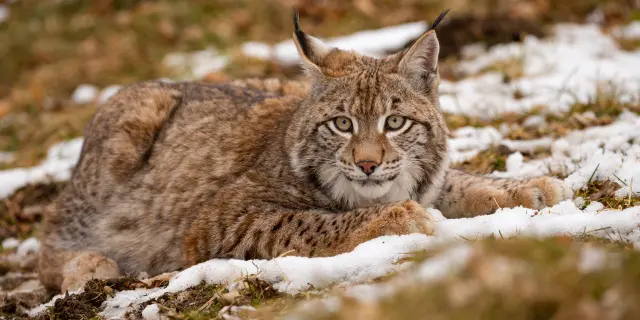
Eurasian lynx face to face in the Bavarian National Park in eastern Germany. European wild cats. Animals in European forests. Lynx lynx.
It is a very secretive, solitary species that requires vast territories, which makes monitoring its population very difficult.
Although a few individuals are occasionally photographed by camera traps across the Chablais region, or signs of the species’ presence are found, it is impossible to draw any conclusions about whether the species is established in the area or about the number of individuals.
Males cover very long distances during the rutting season, and the few individuals observed may simply be passing through.
The Eurasian lynx is a species sensitive to even the slightest disturbance: human activity in natural habitats, roads and villages can act as significant barriers to its establishment.